
Body Intelligence
For much of my life, I overrode my body’s need for rest, softness and slowness, eventually spiralling into exhaustion and burnout. Relearning how to listen to my body has changed my life.
To me, body intelligence is not about fixing or controlling the body. It is about listening. Symptoms are signals. The body is always communicating.
The more I slow down and move with care, the more connected I feel to myself. Warm meals, rest, gentle movement, rituals, safety, pleasure, nature, enough sleep, enough water, enough softness. These things matter deeply.
Our world often praises exhaustion as discipline and productivity as worth. My body completely disagrees.
The practices below help me feel calmer, lighter, more regulated and more at home inside myself.
Qi Gong
Qi Gong has become one of my favourite morning rituals. Even ten minutes of practice noticeably shifts my energy, focus and mood.
After a sunrise walk, warm breakfast and a short rest, I love returning to slow intentional movement and breath. It helps me feel grounded, connected and awake in my body.
I’ve also become deeply drawn to Traditional Chinese Medicine, which views the body as part of nature rather than separate from it. This way of understanding healing feels intuitive to me less about domination or correction, more about balance, rhythm and care.
Lu Chin’s videos are my current favourites.
Somatic
It’s said that the ancient Egyptians, the people of Kemet, understood the lymphatic system as the body’s river of unshed tears. A place where emotion, fluid and memory move together, asking to be witnessed and released.
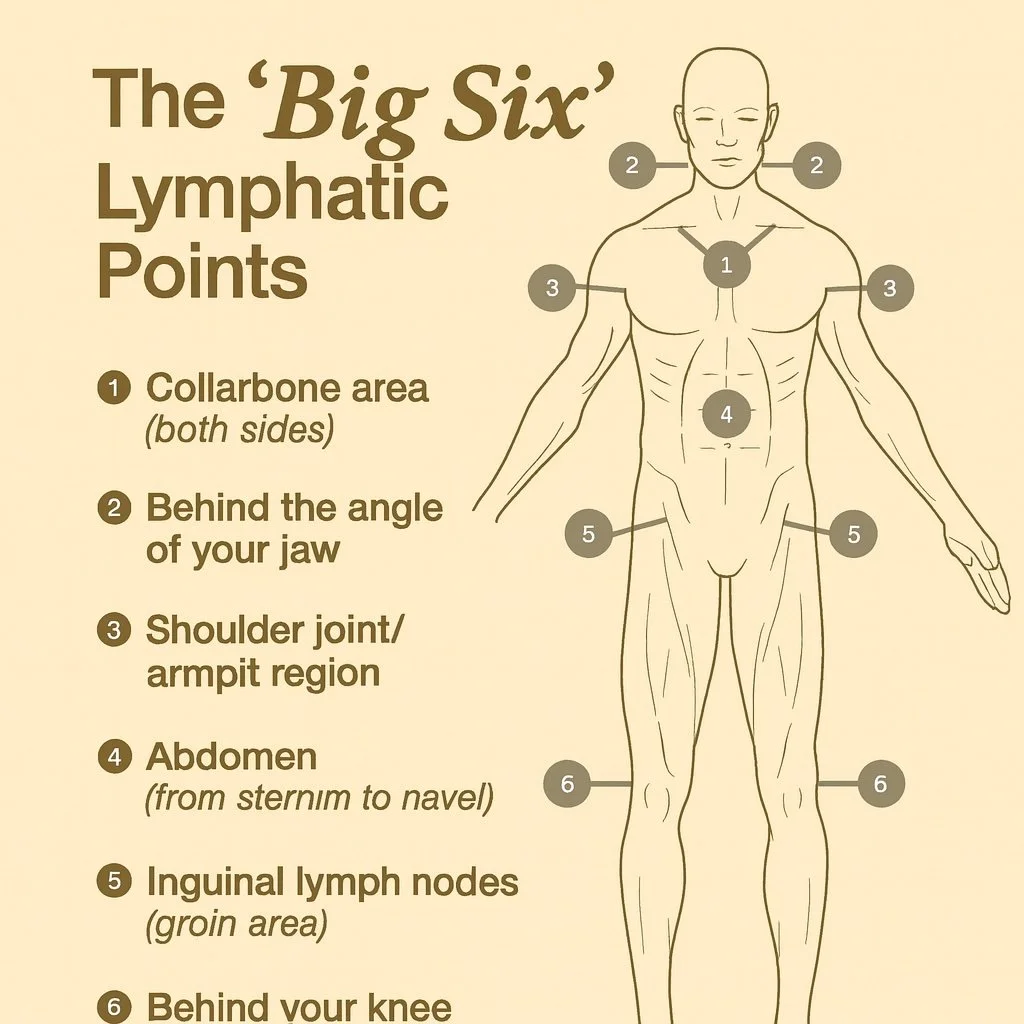
I practice a simple lymphatic detox known as the Big 6 most mornings and evenings. When I’m consistent, I notice significant changes in luteal inflammation and overall lightness in my body. The practice can take anywhere from two to ten minutes, depending of how much time I choose to devote. My favourite way is after I’ve applied some sacred oils, I lie down in bed and spend about a minute at each point, moving slowly and gently. I often finish by placing my legs up the wall, which feels deeply calming and restorative. Extra lush when I apply a heat back over my belly, lower back (kidneys), or lower legs (points of inflammation for me).
The movement itself is simple and rhythmic. At each point, I gently rub the area in small circles ten times, then follow with ten soft pats before moving on. Over time, the practice has become more about tenderness and consistency. When I began, my left point two held the most tension, along with points five and six. With consistent practice, this pain has eased completely, which has deepened my trust in the body’s capacity to respond to slow, attentive care.
This course by the Workout Witch truly helped me feel instant relief. I return to these practices most mornings or before sleep, as they consistently guide my body into a relaxed, restorative state. I’ve purchased both her 30-day Hip course and 18-day Jaw course and couldn’t recommend them both more highly.
Somatic practices have taught me how much the body holds. Areas like the hips and jaw often carry tension, protection and unprocessed emotion, especially after prolonged periods of stress or survival. These practices also support the vagus nerve, helping the nervous system shift out of fight or flight and into rest and repair. Working slowly and gently allows the body to feel safe enough to release, without force. There is much power in nurturing, soothing movement.
Lymph
Cycle Syncing Workouts
Akshaya Agnes has the most beautiful energy and flow.
I’ve learned my body does not like anything high intensity or anything that pushes me past my limits. So now, I only choose Pilates and yoga classes that have an intentional mind-body focus. This allows me to enjoy movement and return again and again.
Many women with sensitive (and powerful) nervous systems do not need added stress, pain or strain. We need safety, rhythm and presence. When this switched for me, I unlocked new levels of strength and flexibility in both yoga and Pilates classes. It was amazingly clear; the slower and more controlled I moved, the better my results and stamina became. Whenever my body signals pain, I pause, breathe, reset and begin again. I never stretch or push past a comfortable pace; I respect my body’s cues and divine intelligence. My body’s needs shift day to day.
My go-to when I feel luteal, tender or tired. I take the 15 mins slow and always feel better after. I feel Bailey Brown’s workouts are gentle, soothing and supportive.